A good siding project should include more than a manufacturer warranty. Learn the difference between product, installation, workmanship, and service warranties—and the questions every homeowner should ask before hiring a siding contractor.
Siding Warranty and Homeowner Protection Guide
```What Warranty Should a Good Siding Contractor Offer?
A good siding project should normally come with more than one layer of protection. Homeowners should understand the difference between the siding manufacturer’s product warranty, the contractor’s installation or workmanship warranty, and the service commitment that determines who actually responds if something needs attention later.
```These protections are related, but they are not interchangeable. A manufacturer may cover a qualifying defect in the siding material while declining responsibility for an installation problem. At the same time, a contractor’s workmanship warranty may cover improper installation but not a manufacturing defect in the panel itself.
```Before signing a siding contract, ask for both warranties in writing and make sure you understand who handles the first phone call if a problem develops.
```The Four Things a Strong Siding Warranty Package Should Address
```- Manufacturer warranty: Protection for qualifying defects in the siding and covered accessories.
- Installation warranty: Protection when the siding system was not installed according to the contract, product requirements, or accepted workmanship standards.
- Workmanship warranty: Written responsibility for problems caused by the contractor’s labor or installation.
- Service commitment: A clear process for inspections, adjustments, warranty questions, and repairs after installation.
Siding Warranty Types at a Glance
```| Protection | Usually Provided By | What It Generally Addresses |
|---|---|---|
| Manufacturer warranty | Siding manufacturer | Qualifying manufacturing defects and any additional coverage specifically stated in the written warranty. |
| Installation warranty | Contractor | Installation-related problems, depending on the written terms. |
| Workmanship warranty | Contractor | Errors in labor, fastening, trim, or other covered workmanship. |
| Service after installation | Contractor or service department | Inspections, adjustments, repair coordination, and warranty assistance. |
Warranty Layer 1
```Manufacturer Product Warranty
The manufacturer warranty covers the siding product according to the written terms issued by the company that made it. This protection is separate from anything promised by the contractor.
Gentek currently states that its qualifying siding and accessory products are backed by lifetime limited transferable warranties. Individual Gentek siding products may also include specified fade and hail protection, subject to the complete written warranty terms and limitations.[1][2]
A manufacturer warranty should always be reviewed as an actual legal document. Words such as “lifetime,” “non-prorated,” “transferable,” “fade protection,” and “hail protection” can have precise definitions, conditions, and exclusions.
```Questions to Ask About the Manufacturer Warranty
```- Which manufacturing defects are covered?
- How long does the coverage last?
- Is the warranty prorated?
- Can it transfer to the next homeowner?
- Does the product include defined fade protection?
- Does it include any hail protection?
- Are accessories covered?
- Is labor included when defective material is replaced?
- Who pays freight, removal, and disposal?
- Does the warranty require registration?
A Manufacturer Warranty Does Not Automatically Cover Installation Problems
```One of the most important distinctions homeowners should understand is the difference between a defective product and defective workmanship.
Contractor guidance from CertainTeed explains that manufacturer warranties cover material defects, while workmanship warranties cover errors made during installation. It also notes that improper installation can affect manufacturer warranty coverage.[3]
If siding buckles because it was nailed too tightly, for example, the panel itself may not be defective. That may instead be a workmanship issue that belongs with the installer.
```Warranty Layer 2
```Installation Warranty
The installation warranty should address how the contractor stands behind the installed siding system.
This is important because vinyl siding performance depends on much more than the panels. Starter strip, corner posts, J-channel, utility trim, fasteners, mounting blocks, soffit, fascia, flashing, and water-resistive barriers can all affect long-term performance.
PEPA’s installation guidance emphasizes following current manufacturer instructions and applicable building-code requirements for proper vinyl siding installation.[4]
```Installation Problems a Contractor Warranty May Address
```- Siding nailed too tightly
- Incorrect fastening or spacing
- Panels not fully locked together
- Improper expansion clearance
- Starter-strip installation problems
- Improperly secured cut panels
- Incorrectly installed trim or accessories
- Installation-related water-management defects covered by the agreement
Warranty Layer 3
```Workmanship Warranty
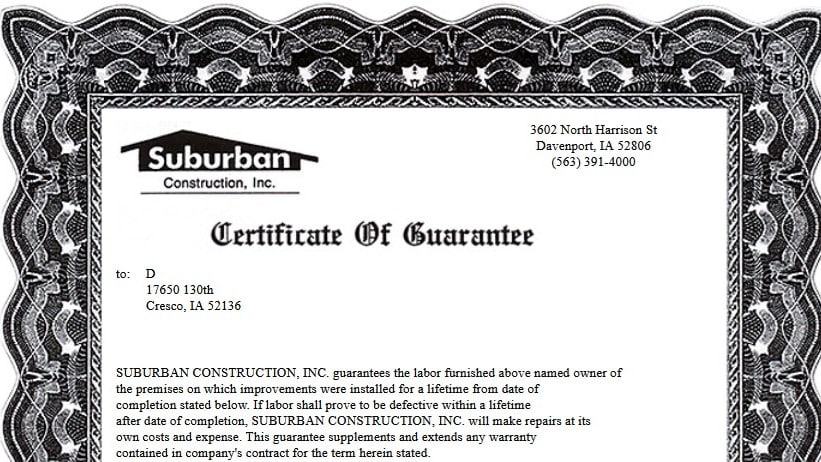
The workmanship warranty is the contractor’s written promise to correct qualifying problems caused by its labor.
There is no single universal warranty length that automatically makes one siding contractor better than another. CertainTeed’s contractor-selection guidance notes that contractors commonly offer workmanship warranties of at least one year and emphasizes that what the warranty covers—and whether the contractor actually stands behind the work—can matter more than simply advertising the longest term.[3]
A long warranty from a company that may not be reachable later is less valuable than a clearly written warranty from an established contractor with a dependable service history.
```What a Good Workmanship Warranty Should Explain
```- How long the warranty lasts
- What installation problems are covered
- What conditions are excluded
- Whether labor is fully covered
- Whether service-call charges apply
- How a homeowner submits a claim
- How quickly the company generally responds
- Whether the warranty transfers with the home
- Who makes the final workmanship determination
- Whether storm or impact damage is excluded
Workmanship and Manufacturer Coverage Should Work Together
```Homeowners should not have to guess which company to call when something goes wrong.
A strong contractor should be willing to inspect the concern, determine whether it appears related to installation or product performance, and help the homeowner understand the next step.
If the issue appears to involve the siding material, the contractor may be able to help document the product, installation date, color, profile, and affected panels for a manufacturer warranty claim.
```Warranty Layer 4
```Service After Installation
A warranty is only as useful as the service behind it.
The homeowner should know exactly who to contact if a panel loosens, trim separates, a storm damages part of the exterior, or a manufacturer warranty question develops.
A contractor with an established local presence and a defined service process can provide value that does not appear on a warranty certificate.
```Good Post-Installation Service Should Include
```- A clear phone number or service-contact process
- Inspection of reported installation concerns
- Documentation of warranty issues
- Help identifying replacement siding after damage
- Coordination with the manufacturer when appropriate
- Clear communication about covered and non-covered repairs
- Access to replacement materials when they remain available
- A record of the original project and products installed
Storm Damage Is Usually Different From a Workmanship Warranty
```A workmanship warranty generally should not be confused with insurance against future hail, tornadoes, falling trees, or extreme wind events.
If siding is damaged by a severe thunderstorm years after a proper installation, the damage may fall under a manufacturer hail provision, homeowners insurance, or an out-of-pocket repair depending on the circumstances and written terms.
The contractor should explain these distinctions before the project begins rather than allowing a homeowner to assume that a broad “lifetime warranty” covers every future problem.
```What About Fading?
```Fading is generally a product-warranty question rather than a workmanship issue, provided the correct product was installed according to requirements.
Some current Gentek vinyl siding products advertise lifetime fade coverage along with lifetime limited transferable warranty protection and hail protection, subject to the actual warranty document.[2][5]
Homeowners should ask how the manufacturer defines excessive fading and what evidence or measurements are required to qualify for coverage.
```What Happens if the Contractor Goes Out of Business?
```This is one reason the stability of the contractor matters almost as much as the written warranty term.
A contractor’s workmanship warranty is generally tied to the company that issued it. If that business disappears, the manufacturer may still honor qualifying product coverage, but it normally does not assume responsibility for unrelated contractor workmanship.
Before signing, ask how long the contractor has operated locally, whether it has a permanent office, and how it has handled warranty service for previous customers.
```Warning Signs in a Siding Warranty
```- The contractor will not provide the warranty before you sign.
- The warranty is entirely verbal.
- The salesperson repeatedly says “everything is covered.”
- Manufacturer and workmanship coverage are presented as the same thing.
- No process is given for requesting service.
- The company cannot explain its exclusions.
- The manufacturer and product line are not identified.
- The contractor cannot explain who pays labor for product replacement.
- The advertised warranty term does not match the written document.
- The contractor has no established local service presence.
Ask for the Actual Documents Before Signing
```Homeowners should receive or review the manufacturer warranty and contractor workmanship warranty before making the final decision.
Do not rely only on a brochure headline or salesperson’s description. Read the exclusions, transfer terms, claim procedures, registration requirements, labor provisions, and limitations.
Keep copies of the contract, final invoice, siding manufacturer, product line, color, installation date, warranty documents, and any product registration confirmation.
```Keep This Information After Your Siding Project
```- Signed contract
- Final invoice
- Siding manufacturer
- Exact product line and profile
- Color name
- Installation completion date
- Manufacturer warranty
- Contractor workmanship warranty
- Warranty registration information
- Contractor service contact
- Extra siding panels saved from the project
```“A good siding warranty should be easy for the homeowner to understand. The manufacturer should stand behind the product, the contractor should stand behind the installation, and the homeowner should know who to call if something needs attention later. The service behind the warranty matters just as much as the number of years printed on the page.”
```
Questions to Ask Every Siding Contractor About Warranty Coverage
```- What manufacturer warranty comes with this exact siding product?
- Can I read the complete warranty before signing?
- What workmanship warranty does your company provide?
- What installation problems are covered?
- What is specifically excluded?
- Is labor included when warranty work is required?
- Who handles manufacturer claims?
- How do I request service after installation?
- Does either warranty transfer if I sell my home?
- How long has your company been servicing previous siding installations?
Do Not Judge a Warranty Only by Its Length
```A 20-year promise is not automatically better than a shorter warranty if the longer document contains substantial exclusions or the contractor has no reliable service operation.
Look at the coverage, exclusions, company stability, service process, response history, and whether the contractor is willing to put its obligations in writing.
The strongest warranty is one that clearly defines responsibility and is backed by companies that are likely to be available when you need them.
```Compare More Than the Siding Price
```When comparing siding contractors, ask about the product warranty, workmanship coverage, installation standards, and service process along with the total project cost.
Schedule a free exterior consultation with Suburban Construction Inc. to discuss siding products, warranty protection, installation, and long-term service for your Quad Cities home.
```Warranty and Installation References
```- Gentek Building Products, Current Siding and Exterior Cladding Warranty Information.
- Gentek Building Products, Current Vinyl Siding Product Warranty and Coverage Information.
- CertainTeed, How to Hire a Contractor — Manufacturer and Workmanship Warranty Guidance.
- Polymeric Exterior Products Association, Vinyl Siding Installation Manual.
- Current manufacturer warranty documents, product specifications, installation instructions, maintenance requirements, registration procedures, and claim instructions for the selected siding.
Warranty note: Warranty duration, transferability, labor coverage, fade provisions, hail provisions, exclusions, maintenance requirements, and claim procedures vary by manufacturer, product, contractor, and installation. The complete written warranty documents control coverage. This article provides general educational information and does not modify any manufacturer or contractor warranty.
```Share This Post
Share it on Facebook or X, or send it through your device share sheet for Instagram.