How much insulation is inside a fiberglass or steel entry door? Learn how polyurethane foam cores, fiberglass, and steel doors compare for energy efficiency, comfort, durability, and long-term value in Quad Cities homes.
How Much Insulation Is Inside a Fiberglass or Steel Door?
One of the biggest improvements in today's entry doors isn't something you'll ever see—it's what's inside them. Modern fiberglass and steel entry doors are built around high-density insulating foam cores that dramatically outperform the hollow or lightly insulated doors installed decades ago.
While homeowners often ask how much insulation is inside the door, the better question is how well the entire door system performs. The insulation inside the slab is important, but the frame, weatherstripping, threshold, glass package, and installation all contribute to the comfort and efficiency you'll experience every day.
What's Inside a Modern Entry Door?
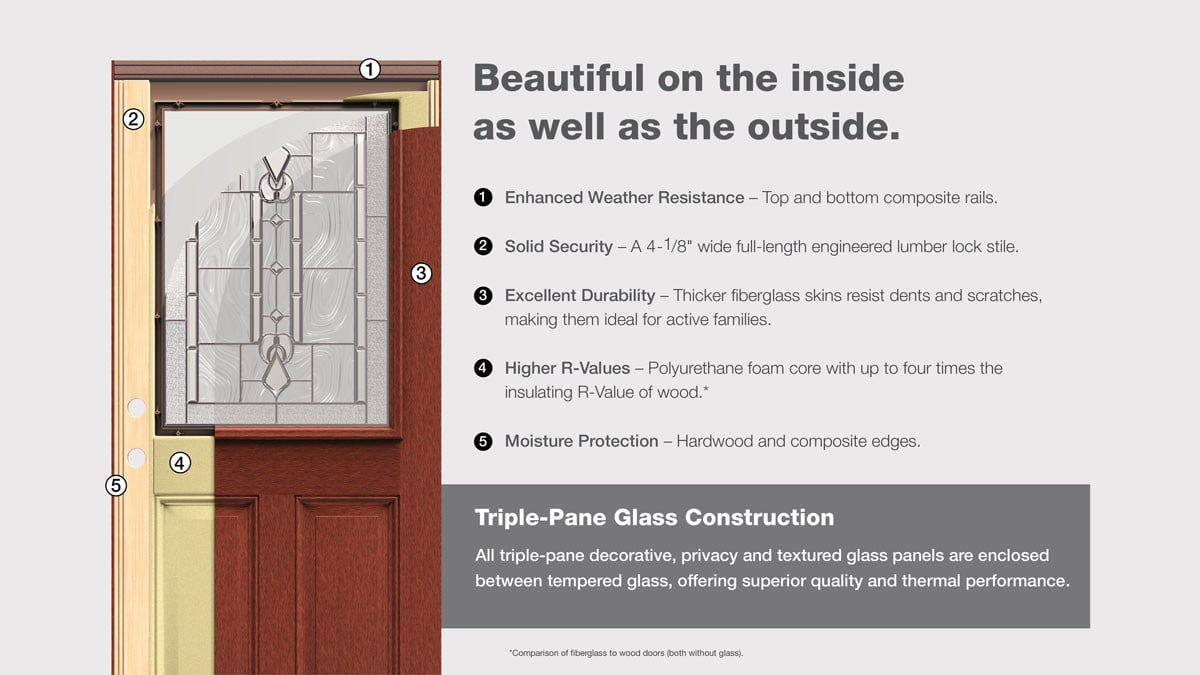
Most premium fiberglass and steel entry doors are filled with a high-density polyurethane foam core. This closed-cell insulation provides exceptional thermal performance while adding rigidity to the door slab without making it excessively heavy.
Unlike older wood doors that relied primarily on the thickness of the wood itself, today's insulated door systems are engineered to reduce heat transfer, improve comfort, and maintain structural stability through changing temperatures.
Where Does the Insulation Come From?
- High-density polyurethane foam core inside the door slab.
- Insulated composite edge construction on many premium doors.
- Compression weatherstripping around the frame.
- Adjustable threshold that seals the bottom of the door.
- Insulated Low-E glass when decorative glass is included.
- Professional installation that seals the rough opening.
Fiberglass vs. Steel: Which Insulates Better?
Both fiberglass and steel entry doors commonly use similar high-performance foam insulation inside the door slab, so overall energy efficiency often depends more on the complete door system than on the exterior skin alone.
For many Quad Cities homeowners, the decision comes down to lifestyle and priorities rather than insulation values alone.
Fiberglass Doors
- Excellent dent resistance.
- Very low maintenance.
- Realistic wood-grain appearance.
- Outstanding long-term durability.
- Won't rust or corrode.
Steel Doors
- Often a lower initial investment.
- Strong, solid feel when closing.
- Smooth painted finish.
- Excellent value for many homeowners.
Fiberglass generally wins for homeowners who prioritize long-term appearance, dent resistance, and minimal maintenance. Steel doors often appeal to those seeking a more budget-conscious option with a substantial feel. Both can provide excellent energy efficiency when professionally installed.
Don't Forget the Glass
Decorative glass doesn't automatically reduce efficiency. Today's insulated decorative glass units feature Low-E coatings and insulated construction that complement the energy performance of the door itself.
Glass should balance daylight, privacy, security, and architectural style rather than focusing on just one feature. For homes close to the street, textured or decorative privacy glass paired with carefully proportioned sidelights often creates the ideal combination of natural light, comfort, and privacy.
What Does FGIA (Formerly AAMA) Say?
The Fenestration and Glazing Industry Alliance (FGIA), formerly the American Architectural Manufacturers Association (AAMA), develops performance standards for complete entry door systems, including air leakage, structural performance, water penetration resistance, and durability. These standards evaluate the complete assembly—not just the insulated door slab.
Proper installation is equally important. A well-insulated door cannot perform as designed if the frame isn't properly shimmed, insulated, flashed, and sealed. Professional installation helps homeowners receive the full benefit of the manufacturer's engineered performance.
Expert Guidance from Suburban Construction
Since 1985, Suburban Construction has completed more than 40,000 exterior remodeling projects throughout the Quad Cities. President JR Girskis and Vice President Darin Wilson have spent decades helping homeowners compare fiberglass and steel entry doors based on energy efficiency, durability, maintenance, appearance, and long-term value—not simply the amount of insulation inside the door.
Their experience helps homeowners select the right Therma-Tru® entry door system for their home, lifestyle, and budget while ensuring every component of the entry works together for lasting performance.
Backed by a Lifetime Written Workmanship Warranty
Every entry door installation from Suburban Construction is backed by a Lifetime Written Workmanship Warranty. While manufacturers warranty the door components themselves, Suburban stands behind the craftsmanship of every installation. Proper sealing, insulation, threshold adjustment, and finishing details help ensure your new entry door performs efficiently for decades.
The Bottom Line
Modern fiberglass and steel entry doors both contain high-density insulating foam that delivers outstanding energy efficiency. The difference between the two is usually less about insulation and more about maintenance, appearance, durability, and budget. The best-performing entry door is one that's professionally installed as a complete system, with quality weatherstripping, insulated glass, and careful attention to every detail that keeps your home comfortable through every Quad Cities season.
Share This Post
Share it on Facebook or X, or send it through your device share sheet for Instagram.
More Door Guides
From the Doors Learning Center — Materials & Products