Before hiring a siding contractor, ask about registration, insurance, local experience, products, flashing, wall preparation, crews, warranties, payment terms, permits, and service after installation. This homeowner checklist helps you compare siding proposals with confidence.
Siding Contractor Hiring Guide
```Questions Every Homeowner Should Ask Before Hiring a Siding Contractor
Hiring a siding contractor is a major decision. The company will work on one of your home’s most important protective systems, including the siding panels, flashing, water-resistive barrier, windows, doors, soffit, fascia, trim, and exterior penetrations.
```A good contractor should be able to explain what products will be installed, how the wall will be prepared, who will perform the work, what happens if hidden damage is discovered, and who will respond if service is needed later.
```Homeowners should ask these questions before signing a contract—not after the old siding has been removed and the project is underway.
```Why the Questions You Ask Matter
```Two siding estimates can appear similar while including very different products, preparation, flashing, accessories, warranties, and service.
One contractor may include sheathing repairs, housewrap, window flashing, mounting blocks, permits, disposal, and manufacturer-compatible trim. Another may quote only the visible siding panels and labor.
Asking detailed questions helps you compare the complete exterior system rather than choosing solely by the final price.
```Contractor Questions at a Glance
```| Question | Why It Matters | What a Strong Answer Includes |
|---|---|---|
| Are you registered, licensed, and insured? | Helps verify the contractor’s legal standing and financial protection. | Current documentation and permission to verify it independently. |
| What exact siding will you install? | Product lines differ in profile, thickness, performance, appearance, and warranty. | Manufacturer, product line, profile, color, texture, and written specifications. |
| What preparation and flashing are included? | The concealed wall details often determine long-term performance. | Clear scope for sheathing, housewrap, windows, doors, rooflines, and penetrations. |
| Who will perform the work? | The salesperson may not be the person supervising or installing the project. | Crew structure, supervision, training, and subcontractor information. |
| What happens after installation? | Future service and warranty support may be needed. | A written workmanship warranty and a clear service-contact process. |
Question 1
```Are You Properly Registered or Licensed?
Ask which state and local registrations, licenses, or permits apply to the work. Requirements differ between Iowa and Illinois and may also vary by municipality.
Iowa requires construction contractors performing qualifying work and earning at least $2,000 annually from construction to register with the Department of Inspections, Appeals, and Licensing.[1]
Registration or licensing does not guarantee quality, but a contractor who refuses to provide verifiable credentials should be treated cautiously.
```Question 2
```Can You Provide Current Proof of Insurance?
Ask for proof of general liability insurance and workers’ compensation coverage when applicable.
Confirm that the business name on the insurance certificate matches the name on the contract. The coverage dates should extend through the expected project period.
The Federal Trade Commission recommends checking licenses and insurance before hiring a home-improvement contractor.[2]
```Question 3
```How Long Have You Been in Business?
Ask how long the company has operated under its current name and ownership. Years of industry experience are useful, but they are not the same as years operating the present business.
An established company should be able to show completed local projects, provide references, explain its service history, and identify where homeowners can reach it after installation.
Newer companies may still perform excellent work, but they should provide strong documentation of installer experience, insurance, training, supervision, and warranty support.
```Question 4
```Do You Have a Local Office or Showroom?
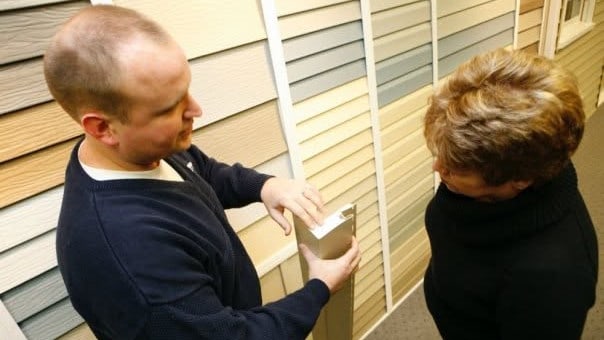
A permanent local location gives homeowners a place to view materials, compare colors, ask questions, and request service later.
A showroom is especially valuable for siding because computer screens and printed brochures cannot fully reproduce the texture, gloss, and color of the actual product.
Ask whether the location is regularly staffed and whether the company has operated there long enough to demonstrate a stable local presence.
```Question 5
```Can You Provide Recent Local References?
Ask for references from projects similar to your own. A simple ranch-home installation may not demonstrate experience with multi-story walls, historic homes, bay windows, masonry transitions, complex rooflines, or concealed water damage.
Ask Previous Customers:
- Did the company begin and finish near the expected dates?
- Did the final price match the written agreement?
- Was the project manager easy to reach?
- Did the crew protect landscaping and exterior property?
- Was the worksite cleaned regularly?
- Were unexpected repairs explained before additional work began?
- Has the contractor responded to service requests since completion?
Question 6
```What Exact Siding Product Are You Quoting?
Do not accept a proposal that identifies the material only as vinyl siding. Ask for the exact manufacturer, product line, profile, color, texture, nominal thickness, and warranty.
Request a current product sample and the manufacturer’s written technical information. Confirm that the sample matches what will be delivered to the project.
The proposal should also identify whether the project uses traditional vinyl siding, insulated siding, shakes, vertical siding, board-and-batten, or another specialty product.
```Question 7
```Are the Siding and Accessories Manufacturer-Compatible?
Starter strip, J-channel, corner posts, utility trim, lineals, soffit, fascia, mounting blocks, and vents should be appropriate for the selected siding profile.
Standard accessories may not provide enough receiving depth for insulated siding, shakes, or other thicker products.
Ask whether the contractor is using manufacturer-matched components or substituting generic accessories to reduce cost.
```Product Questions to Include
```- Is the product certified to the applicable standard?
- What wind information applies to this specific panel?
- What fade, hail, or product-defect coverage is included?
- What accessories are required for the profile?
- Are all colors available in the required soffit, fascia, trim, and rainware products?
- How easy will it be to obtain replacement panels later?
- Will leftover siding remain with the homeowner?
Question 8
```How Will You Prepare the Existing Wall?
Vinyl siding should be installed over a smooth, flat, sound surface. Ask how the contractor will handle loose existing materials, uneven sheathing, protruding fasteners, damaged trim, and deteriorated wood.
Industry installation guidance states that vinyl siding should be applied over sheathing or backerboard that provides a smooth, flat surface.[3]
The contractor should explain what wall preparation is included and how additional sheathing repairs will be priced if damage is discovered.
```Question 9
```Will You Remove the Existing Siding?
Some projects involve full removal, while others may install new siding over an approved existing surface. Ask which method is being proposed and why it is appropriate for your home.
Removal allows more direct inspection of the sheathing, flashing, water-resistive barrier, and concealed damage. Installing over existing siding may require additional preparation to create a flat surface.
The written scope should identify removal, disposal, wall preparation, and any materials that will remain in place.
```Question 10
```What Water-Resistive Barrier Is Included?
Vinyl siding is an exterior cladding, not the only water-control layer. Ask which housewrap or water-resistive barrier will be installed, repaired, or retained.
The contractor should explain how seams, corners, windows, doors, penetrations, and roof intersections will connect to the drainage plane.
A proposal that does not address the water-resistive barrier leaves one of the most important parts of the wall unclear.
```Question 11
```How Will You Flash Windows, Doors, and Roof Intersections?
Ask the contractor to explain the sill, jamb, and head-flashing approach around windows and doors. Also ask how step flashing, kick-out flashing, deck ledgers, additions, and utility penetrations will be addressed.
The Vinyl Siding Institute installation manual provides general industry practices based partly on ASTM D4756, but it emphasizes checking current manufacturer instructions and local building requirements.[4]
Decorative trim, J-channel, aluminum capping, and sealant should not be presented as substitutes for properly integrated flashing.
```Question 12
```How Will the Siding Be Fastened?
The contractor should understand that vinyl siding must be secured while remaining free to expand and contract.
Ask what fasteners will be used, how far they will penetrate, how spacing is determined, and how the crew avoids overdriving them.
A vague answer such as “we nail it like every other siding job” may indicate that the installer is not considering the specific product requirements.
```Question 13
```Who Will Actually Install the Siding?
Ask whether the crew consists of employees, subcontractors, or a combination of both. Subcontracting is common and does not automatically indicate poor quality.
The important questions are who supervises the work, who confirms installation quality, who handles corrections, and whether all workers are properly covered by the contractor’s insurance arrangements.
Ask whether a project manager will visit the site and who your day-to-day contact will be.
```Question 14
```What Happens if You Find Rot or Damaged Sheathing?
Hidden damage is common around windows, doors, decks, roof intersections, and areas affected by previous leaks.
Ask whether work stops for homeowner approval, how the damaged area will be documented, and what labor and material rates apply to additional repairs.
The contractor should not cover wet, rotted, or structurally unsuitable materials simply to remain within the original price.
```Ask How Change Orders Are Handled
```- Will additional work be described in writing?
- Must the homeowner approve the price before work continues?
- Will photographs of hidden damage be provided?
- Are labor and material rates listed in the original contract?
- Will the project schedule change?
- How will added work affect the warranty?
Question 15
```Who Obtains the Permits?
Ask whether permits are required and who is responsible for obtaining them. The contract should identify whether permit fees are included.
A contractor who tells the homeowner to obtain a contractor-related permit may be attempting to avoid responsibility or local verification.
Contact the applicable city or county office when permit responsibilities remain unclear.
```Question 16
```What Is Included in the Written Estimate?
The Federal Trade Commission recommends obtaining multiple written estimates and reviewing a signed contract before home-repair work begins.[2]
A complete siding estimate should identify the products, quantities, preparation, accessories, flashing, disposal, cleanup, permits, payment schedule, warranties, and expected project timing.
Compare exclusions as carefully as inclusions. The lowest estimate may omit critical work that appears in another contractor’s scope.
```The Written Proposal Should Identify:
```- Contractor’s legal business name and address
- Siding manufacturer, product line, profile, color, and texture
- Housewrap or water-resistive barrier
- Window, door, roofline, and penetration flashing
- Starter strip, corner posts, channels, utility trim, and mounting blocks
- Soffit, fascia, gutters, shutters, vents, and trim coil
- Existing material removal and disposal
- Wall preparation and sheathing repairs
- Permit and inspection responsibilities
- Workmanship and manufacturer warranties
- Payment schedule and estimated start and completion dates
Question 17
```What Payment Schedule Do You Require?
Be cautious of contractors demanding full payment before materials arrive or work begins.
The payment schedule should correspond to meaningful project stages and should be included in the written agreement.
The FTC advises homeowners not to pay home-repair contractors by cash or wire transfer and recommends reviewing the complete contract before work begins.[5]
```Question 18
```What Manufacturer Warranty Applies?
Ask for the complete written warranty rather than relying on phrases such as lifetime siding or lifetime protection.
Review what defects are covered, whether fade or hail provisions apply, whether coverage is prorated, what exclusions exist, and whether the warranty transfers to a future homeowner.
Ask whether registration is required and who will provide the final product information needed for a future claim.
```Question 19
```What Workmanship Warranty Do You Provide?
Manufacturer warranties generally address qualifying product issues. They do not replace the contractor’s responsibility for installation.
Ask how long the workmanship warranty lasts, what it covers, what is excluded, and how a service request is submitted.
The warranty should be written into the agreement or provided as a separate written document before the contract is signed.
```Question 20
```Who Handles Service After Installation?
Ask who will answer if a panel loosens, a trim piece separates, or a warranty question develops several years later.
Determine whether the company has a service department, whether repairs are completed by its own team, and how quickly service requests are normally acknowledged.
A contractor’s willingness to discuss future service before the sale can reveal a great deal about its long-term commitment.
```Question 21
```Can I Review Your Google Reviews and Recent Projects?
Online reviews can reveal patterns involving communication, cleanup, scheduling, sales practices, installation quality, and service.
Read detailed reviews rather than focusing only on the average rating. Pay attention to how the company responds when a customer reports a problem.
Reviews should support—not replace—insurance verification, local references, written contracts, product documentation, and direct questions.
```Question 22
```How Will You Protect My Property?
Ask how the crew will protect windows, landscaping, driveways, decks, air-conditioning equipment, lighting, vehicles, and outdoor furniture.
The contractor should explain how old siding and nails will be collected, where materials will be stored, and how the property will be left at the end of each workday.
Cleanup should be included in the written scope rather than treated as an informal promise.
```Question 23
```How Will You Handle Severe Weather During the Project?
Once siding has been removed, parts of the wall may be temporarily more exposed. Ask how the contractor monitors the forecast and protects open walls overnight.
The contractor should avoid removing more material than can be safely prepared and protected before changing weather arrives.
Temporary protection should not become a substitute for properly completing the water-resistive barrier and flashing.
``````“Homeowners should ask about more than the siding color and total price. The important questions involve the wall preparation, flashing, housewrap, accessories, fasteners, installer experience, warranty, and who will provide service later. A contractor who answers those questions clearly is giving the homeowner a much better picture of the complete project.”
```
Warning Signs Before You Sign
```- The contractor pressures you to sign immediately.
- The company will not provide proof of insurance.
- The proposal does not identify the exact siding product.
- Flashing and housewrap are not discussed.
- The contractor discourages permits or inspections.
- Large cash payment or wire transfer is requested.
- Warranty promises are verbal rather than written.
- Local references cannot be provided.
- The company has no stable business address.
- Blank spaces remain in the contract.
- The contractor promises that insurance will definitely pay.
- You are told not to compare other estimates.
Special Contract Considerations in Illinois
```Illinois consumer guidance states that a contractor must provide the Home Repair: Know Your Consumer Rights information for qualifying home-repair work. For contracts over $1,000, the homeowner and contractor must sign an acknowledgment confirming that the brochure was received.[6]
Illinois guidance also identifies basic contract information such as the contractor’s name, address, telephone number, description of the work, project dates, and total cost.[7]
Homeowners should review current state and local requirements because legal obligations can change and may depend on the project.
```Why Hiring a Local Contractor Matters
```A siding project may require service long after the final invoice is paid. Storm damage, accidental impacts, warranty claims, window replacement, and exterior adjustments can all create future needs.
An established local contractor has a reputation to protect and is more likely to remain accessible when questions or service needs arise.
Local companies are also familiar with Quad Cities weather, common housing styles, older siding products, local suppliers, and permitting practices.
When investing thousands of dollars in your home, knowing where the contractor is located and who will answer years later provides meaningful peace of mind.
```Ask Questions Until the Project Is Clear
```A professional contractor should not become defensive when you ask about credentials, products, flashing, crews, warranties, or payment terms.
Clear answers protect both the homeowner and the contractor by reducing misunderstandings before materials are ordered and work begins.
Do not sign until the complete scope, price, products, exclusions, payment schedule, and warranty obligations are understandable and documented.
```Planning a Siding Project?
```A good siding consultation should give you clear information about the product, preparation, installation, warranty, and service—not pressure you into making an immediate decision.
Schedule a free exterior consultation with Suburban Construction to compare siding options and discuss the complete scope of your project.
```Consumer and Installation References
```- Iowa Department of Inspections, Appeals, and Licensing, Contractor Registration.
- Federal Trade Commission, How to Avoid a Home Improvement Scam.
- Polymeric Exterior Products Association, Vinyl Siding Installation Manual: Getting Started.
- Polymeric Exterior Products Association and the Vinyl Siding Institute, Vinyl Siding Installation Manual.
- Federal Trade Commission, Home Repair Scams Consumer Guidance.
- Illinois Attorney General, Home Repair: Know Your Consumer Rights.
- Illinois Attorney General, Home Repair and Construction: What You Should Know.
- Current installation instructions, technical specifications, accessory requirements, warranty documents, and maintenance guidance published by the manufacturer of the selected siding.
Consumer note: Contractor registration, licensing, insurance, permits, consumer notices, cancellation rights, and contract requirements vary by state, municipality, project type, and contract amount. This article provides general educational information and does not replace current legal requirements, manufacturer instructions, or professional legal advice.
```Share This Post
Share it on Facebook or X, or send it through your device share sheet for Instagram.