Vinyl siding that keeps blowing off usually points to an underlying problem such as improper nailing, restricted expansion, broken locks, old siding, high wind exposure, or installation mistakes. Learn what causes repeated siding failure and when repair becomes replacement.
Vinyl Siding Problem-Solving Guide
```Why Does My Vinyl Siding Keep Blowing Off?
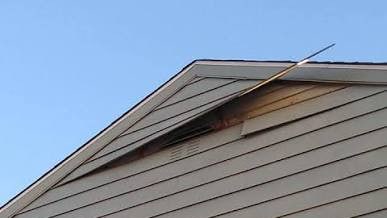
Vinyl siding that repeatedly comes loose is usually showing a deeper problem. Strong wind may be the event that exposes the weakness, but the underlying cause is often improper nailing, restricted panel movement, damaged locks, aging material, or an installation detail that was never completed correctly.
```A single panel can sometimes be reconnected after a storm. When the same area continues to loosen, rattle, or blow off, simply snapping it back into place is unlikely to provide a lasting repair.
```The best solution begins with identifying why the siding is failing. The panel, fasteners, locking edges, starter strip, wall surface, trim accessories, and surrounding courses should all be inspected before the repair is completed.
```Wind Is Often the Trigger, Not the Root Cause
```Properly installed vinyl siding is designed to handle normal wind exposure while remaining free to expand and contract. Wind creates pressure against one side of the home and suction around corners, rooflines, and wall edges.
If a panel is poorly fastened, improperly locked, brittle, or installed too tightly, those pressure changes can pull it away from the wall.
This is why one side of a home may experience repeated problems while the remaining walls appear secure.
```Common Reasons Vinyl Siding Blows Off
```| Possible Cause | What Happens | Typical Solution |
|---|---|---|
| Improper nailing | Panels are too loose, poorly supported, or fastened outside the intended nail slots. | Remove enough siding to correct the fastening pattern. |
| Restricted expansion | Panels buckle, distort, or push against trim when temperatures rise. | Restore proper clearances and fastening movement. |
| Old or brittle siding | Locking edges crack or lose their ability to stay engaged. | Replace damaged sections or consider broader replacement. |
| High wind exposure | Corners, gables, and open elevations experience repeated pressure and suction. | Inspect product rating, fastening, locks, and edge details. |
| Installation mistakes | Starter strip, accessories, panel locks, or wall preparation may be incorrect. | Rebuild the affected area according to manufacturer instructions. |
Cause 1
```Improper Nailing
Vinyl siding is not installed like wood siding. It should not be nailed tightly against the wall. Fasteners are placed through elongated nail slots so the panel remains supported while still being able to move.
Several fastening mistakes can make siding more likely to blow off:
- Too few fasteners across the panel
- Fasteners placed too far apart
- Nails driven outside the designated slots
- Fasteners that do not penetrate the approved substrate
- Nails driven at an angle
- Fasteners that are too short or not corrosion-resistant
- Nails driven too tightly against the nailing hem
A panel can appear secure immediately after installation and still fail later when wind pressure or temperature movement places stress on the incorrect fastening pattern.
```Why Overdriven Nails Cause Problems
```Nails driven tightly against the siding can prevent the panel from moving. As the vinyl expands, it may buckle, bow, or push against nearby trim.
That pressure can weaken the lock between siding courses. Once the locking edge becomes distorted or partially disengaged, wind can get behind the panel and pull it loose.
A proper repair may require removing several courses so the fasteners can be repositioned—not simply reconnecting the lower lock.
```Cause 2
```Insufficient Expansion and Contraction Clearance
Vinyl siding changes length as temperatures rise and fall. Every panel needs room to move inside corner posts, J-channel, window trim, door trim, and other receiving accessories.
If a panel is cut too tightly, summer heat may cause it to push against the trim and buckle away from the wall. When temperatures fall, the distorted lock may not return to its original position.
Panels that are cut too short can create a different problem. During cold-weather contraction, the end may pull out of the receiving channel and become more vulnerable to wind.
```Signs the Siding Cannot Move Properly
```- Waves or ripples across the wall
- Panels that bow outward near windows or corners
- Siding that feels rigid when pushed side to side
- Ends pressed tightly into J-channel or corner posts
- Fastener heads tight against the nailing hem
- Repeated separation during seasonal temperature changes
- Cracked or stretched panel locks
Cause 3
```Old or Brittle Vinyl Siding
Vinyl siding can remain serviceable for many years, but older panels may become less flexible after prolonged weather and ultraviolet exposure.
Brittle siding is more likely to crack during impact, cold weather, removal, or repeated wind movement. The lower locking edge may split or stretch even when the front of the panel appears relatively normal.
When the lock has deteriorated, snapping the panel back together may only provide a short-term result. The panel can separate again during the next high-wind event.
```When Aging Siding Becomes Difficult to Repair
```Older siding can create several repair challenges at once. The original product may be discontinued, the color may have faded, and the surrounding panels may crack when they are unlocked.
Repeated spot repairs may become less practical when every service call reveals another brittle lock or damaged course.
In these cases, replacing a complete wall or the entire siding system may provide better long-term value than continuing to reconnect aging panels.
```Cause 4
```High Wind Exposure
Wind pressure is not equal across every part of a home. Outside corners, gable ends, roof edges, upper stories, and open elevations often experience stronger forces than protected walls.
A home surrounded by open fields, located on elevated ground, or exposed to prevailing winds may experience more stress than a home protected by neighboring buildings or mature trees.
If siding repeatedly fails in one exposed area, the inspection should include the panel locks, fastener spacing, substrate, corner posts, J-channel, starter strip, and the product’s suitability for the installation.
```Why Corners and Gables Often Fail First
```Air moving around a building can create suction at corners and along roof edges. If a panel end is too short, poorly engaged, or inadequately fastened, wind may enter behind it.
Gable siding can also be vulnerable when angled cuts fit poorly inside the receiving channels or when access during the original installation made correct fastening difficult.
These areas should be inspected carefully rather than repaired with additional face nails or screws through the visible siding.
```Cause 5
```Installation Mistakes
Siding can blow off when the installation does not follow the panel manufacturer’s requirements. Some defects affect only one area, while others extend across the entire wall.
Common Installation Errors Include:
- Starter strip installed out of level
- First course not fully locked into the starter strip
- Panel locks not engaged continuously
- Incorrect fastener spacing
- Fasteners missing the framing or approved substrate
- Improper clearances at trim and openings
- Incorrect J-channel or corner-post depth
- Panels stretched tightly during installation
- Damaged locks reused instead of replaced
- Manufacturer instructions not followed
The Starter Strip May Be the Problem
```The lowest siding course depends on the starter strip for its initial lock and alignment. If the starter strip is loose, bent, incorrectly positioned, or not firmly attached, the first course can disengage.
Once the bottom course fails, wind can work upward through additional courses and create a larger loose section.
Reconnecting the visible panels without repairing the starter strip may allow the same failure to happen again.
```Why Quick Fixes Often Fail
```- Snapping the panel back in place: This may work only when both locking edges remain undamaged.
- Adding face nails or screws: This creates visible holes and can restrict panel movement.
- Using caulk as an adhesive: Sealant does not restore a broken locking edge and may trap water.
- Repairing only one loose point: The underlying fastening or alignment problem may extend farther across the wall.
- Ignoring damaged housewrap: A loose panel may have exposed or torn the drainage layer behind the siding.
Can Loose Siding Allow Water Behind the Wall?
```Vinyl siding is designed to shed water, but it is not the only water-management layer. The water-resistive barrier and flashing behind it are responsible for directing incidental moisture toward the exterior.
A loose or missing panel exposes these concealed materials to more direct weather. If housewrap, flashing, or sheathing is damaged, wind-driven rain may enter the wall.
This is why a recurring loose-panel problem should be inspected promptly rather than treated as a purely cosmetic issue.
```What a Professional Inspection Should Check
```- Condition of the panel locks
- Fastener type, spacing, position, and penetration
- Whether panels can move side to side
- Expansion clearance at corners and openings
- Starter-strip attachment and alignment
- J-channel and corner-post receiving depth
- Condition of the water-resistive barrier
- Sheathing or framing damage
- Exposure at gables, corners, and rooflines
- Product age and replacement availability
When the Panel Can Be Repaired
```A loose panel may be reusable when the locking edges are intact, the nail hem is undamaged, the surrounding siding remains flexible, and the underlying wall is dry.
The repair should still address any incorrect fasteners, clearances, or alignment that allowed the panel to loosen.
Reconnecting an otherwise sound panel can be a practical solution when the underlying installation is corrected at the same time.
```When the Panel Should Be Replaced
```Replacement is usually recommended when the lower lock is cracked, stretched, torn, or unable to remain engaged.
Panels should also be replaced when the nail hem is broken, the vinyl is brittle, the panel is permanently warped, or previous face-fastening has created multiple holes.
A compatible replacement should match the profile, exposure, locking design, thickness, texture, and color as closely as possible.
```When Repeated Repairs Become Replacement
```One loose panel does not automatically mean the entire home needs new siding. Broader replacement may make more sense when the problem extends across several walls or the existing siding can no longer be repaired reliably.
Consider Larger Replacement When:
- Several areas repeatedly come loose
- The siding is brittle or cracks during removal
- The original product has been discontinued
- Repairs reveal widespread improper fastening
- Starter strip or accessories are failing across the wall
- Water has damaged the sheathing or framing
- Repair costs are becoming repetitive
- Matching panels are visibly different from the existing exterior
```“When siding keeps blowing off, the wind is usually exposing a weakness that is already there. We look at the fasteners, panel locks, expansion clearance, starter strip, product condition, and wind exposure. A lasting repair corrects the reason the siding failed instead of simply snapping the same panel back into place.”
```
Do Not Wait for the Next Storm
```A panel that has already come loose once may separate more easily during the next strong wind. Continued movement can damage adjacent siding and expose the wall behind it.
An early inspection can determine whether the panel can be repaired, whether the fastening needs correction, or whether aging siding should be replaced.
```Schedule a Free Siding Inspection
```If your vinyl siding keeps blowing off, reconnecting the panel without correcting the underlying problem may only delay the next failure.
Schedule a free siding inspection with Suburban Construction to identify the cause and discuss a lasting repair or replacement solution.
```Technical note: Repeated siding failure can result from installation, product age, fastening, substrate conditions, accessory compatibility, wind exposure, storm damage, or a combination of factors. This article provides general educational information and does not replace an on-site inspection or the current installation instructions for the specific siding product.
Share This Post
Share it on Facebook or X, or send it through your device share sheet for Instagram.